

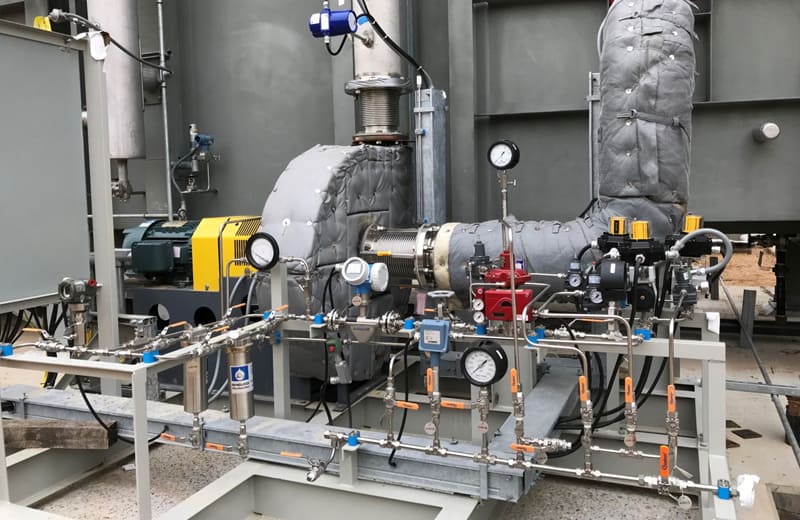
In modern industrial operations and power generation facilities, reducing harmful emissions has become a major operational priority. One of the most important technologies used to control nitrogen oxide (NOx) emissions is the Ammonia Injection Grid (AIG). Ammonia injection grid fabrication requires careful engineering, specialized manufacturing techniques, and a deep understanding of process control systems. Every component must be designed to deliver ammonia accurately and consistently into the flue gas stream to ensure efficient NOx reduction and reliable long-term performance.
An insight into ammonia injection grid fabrication
Ammonia Injection Grid play a vital role in Selective Catalytic Reduction (SCR) and Selective Non-Catalytic Reduction (SNCR) processes by helping facilities minimize pollutants before they are released into the atmosphere. Whether the application involves retrofitting an existing plant or supporting a newly constructed facility, proper ammonia injection grid fabrication is needed to allow operators maintain compliance with environmental standards while improving overall system efficiency.
Before the physical fabrication of the injection grid begins, the ammonia processing and delivery system must be carefully engineered. Facilities may use either anhydrous ammonia or aqueous ammonia depending on the size and requirements of the application. Each system requires specialized handling, flow control, and safety measures to ensure accurate ammonia delivery.
Ammonia processing systems typically include multiple integrated components designed to maintain stable flow and operational safety. These may include strainers, pressure monitoring devices, emergency shutoff valves, control valves, bypass arrangements, flow transmitters, and check valves. Stainless steel piping is commonly used throughout the system because of its corrosion resistance and durability under demanding industrial conditions.
Ammonia injection grid fabrication combines engineering design with highly specialized manufacturing expertise. Injection lances and manifolds must be built to withstand continuous exposure to elevated temperatures, chemical interaction, and industrial operating environments. High-quality welding is a critical part of the fabrication process. Precision welding techniques are often used to ensure strong, reliable joints and leak-free piping assemblies. Because these systems frequently operate under harsh conditions, fabrication quality directly impacts system lifespan, reliability, and overall performance.
Modern fabrication facilities are capable of producing complete custom assemblies tailored to a plant’s exact operating conditions. This includes manifold systems, injection lances, support structures, skidded control units, and integrated instrumentation packages. Each component is manufactured according to applicable industry standards and engineering specifications to ensure dependable operation.
Every industrial facility operates differently, which means no two ammonia injection systems are exactly alike. Factors such as flue gas temperature, duct geometry, flow velocity, boiler size, and emissions targets all influence system design. Because of this, many facilities require customized AIG solutions built specifically for their operational needs.
Custom-designed systems may include automated controls, advanced instrumentation, leak detection systems, local operator panels, and specialized flow management features. This flexibility allows operators to optimize ammonia distribution and improve overall emissions performance.
Some facilities may only require replacement lances or manifold upgrades, while others may need complete skid-mounted ammonia processing systems integrated with their existing SCR or SNCR equipment. Fabricators capable of delivering both packaged and fully custom solutions provide operators with greater flexibility and long-term operational support.
