

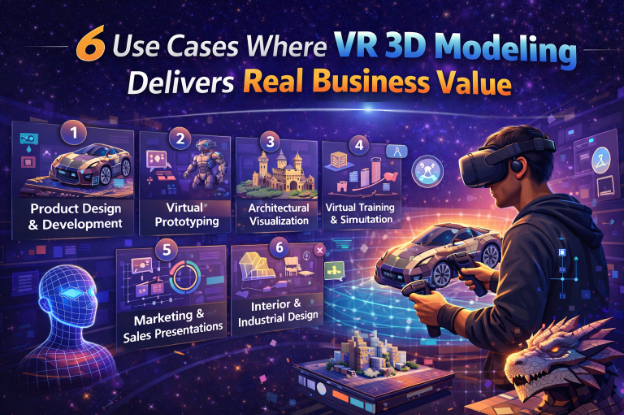
VR has moved beyond being a catchy visual gimmick. When applied appropriately, VR 3D modeling transforms how teams think and design, make decisions, and test. Businesses can instead step into their ideas and implement them at scale, rather than conjecturing how some things may look or feel.
Consequently, that leads to faster decisions, less guesswork, happier clients, and fewer mistakes. These days, VR is being embraced by industries using the proven know-how of a 3D visualization company, and the achieved results are tangible.
Product Design and Pre-Production Validation
From our point of view, the product design area is one of the greatest applications of VR 3D modeling. Instead of viewing flat renders or rotating models on a screen, designers and stakeholders can now walk around their product and inspect proportions and evaluate ergonomics in real space.
This enables the early visibility of faults, many months before building ever begins on a physical prototype. Changes that used to take weeks to implement can now be identified and solved in just one review session, thereby saving time and the cost of materials.
Architecture and Real Estate Visualization
Everything in architecture and real estate starts with space. Floor plans and static renders present many variables that may lead to unintended expectations. VR 3D modeling fills in that gap.
Clients take a walk-through in homes, offices, or commercial spaces long before actual construction begins. They experience actual ceiling heights, room flow, and spatial relationships. This leads to fast-tracked approvals with fewer rounds of revisions and more confidence in final decisions.
Manufacturing Layout and Process Planning
Factory environments are complex, and a small error in layout can result in a large loss in operational efficiency later. With VR, the simulation of factory floor settings, the placement of machinery, and the paths of workflows can be validated by all teams before anything is actually built. With VR 3D modeling, engineers can test movement, safety clearances, and production flow at full scale.
Along the way, any problems that would otherwise have come up after installation are caught at an early stage, thereby lessening downtime and the cost of rework. For manufacturers, this directly converts to savings in terms of operations.
Training and Skill Development
One-on-one involvement is another way in which virtual reality has directly benefited an organization. In training, it has encouraged employees to practice in environments simulated as closely as possible to life, where they carry out specified tasks, and not read out of manuals and videos.
Be it equipment operation, safety training, or even complex assembly procedures, VR improves retention and turnover from training. These advantages include accelerated onboarding, fewer accidents, and more trust and confidence amongst teams. VR 3D modeling creates an environment of practicality, repeatability, and scalability in training.
Marketing and Client Presentations
In marketing complex or high-value products, traditional materials are usually found wanting. VR creates memorable experiences, which instantaneously show clients the value. A product demo in a VR world is far more interesting than just a brochure or slideshow. Those who apply VR 3D modeling to presentations usually notice shorter selling cycles because clients begin to map concepts much quicker with diminished follow-up questions. It’s not just about style but also clarity and confidence.
Collaborative Design Across Remote Teams
A majority of teams find themselves positioned across cities or even continents. VR shortens that distance. Designers, engineers, and decision-makers convene within the same virtual model to review changes and direct decisions collectively. This also alleviates idle back-and-forth emails and ill-informed feedback.
As everyone works with the same concept and view, collaboration runs more smoothly and productively. Well-established 3D visualization companies help set up such workflows, enhancing teamwork on ideas rather than tools.
Why Businesses Are Investing in VR Now
What ties all of these applications together is speed and assurance. VR 3D modeling often reduces assumptions. Experience replaces interpretation. That transition gets the ball rolling with fewer revisions, speedier approval, and more certain outcomes.
The business world has come to the consciousness of the need for early investment into developing VR, as tools and facilities to pursue development have become cheaper and readily available through enhancements in generated time and accuracy.
Conclusion
VR is creating value because it solves problems for real, not because it looks impressive. VR 3D modeling helps the business streamline designs and processes, generate knowledge, and make quicker and more informed decisions across the manufacturing, training, and sales segments, thus reducing their risks.
When implemented mindfully with an experienced 3D visualization company, though, VR becomes much more than a visualization layer: it is a powerful tool for increasing efficiency, clarity, and substantial output through a number of workflow stages.
