

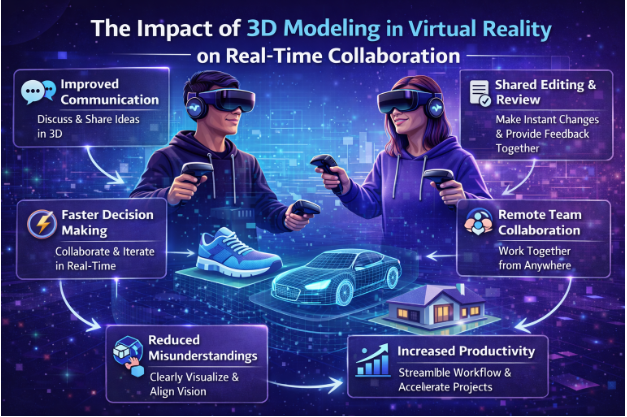
Team collaboration has always remained an integral part of designing, although the traditional ways of designing and collaboration greatly resisted effective team collaboration and decision-making. Often, screen-based solutions, graphics, and the feedback cycle could hold them back or cause conflicts to arise.
The design that was becoming increasingly complex and global needed a better way to allow for real-time team collaboration. Thus, the 3D modeling in virtual reality is definitely bringing a radical transformation to the team collaboration design methods.
Virtual reality is taking collaboration from talking about designs from afar into actually experiencing the designs themselves together, allowing multiple parties to enter the same virtual reality space.
Evolutions in Design Process Collaborations through Real-Time Technology
Traditional collaboration amongst individuals mainly involved meetings, screen-sharing remotely, and the sharing of files. While the process was indeed very efficient, tangible differences could often exist between the conceptualization of the designer and the perception of the other party.
Within immersive virtual environments, collaboration becomes spatial collaboration: instead of discussing the design, teams move through it. This helps speed up learning and gives confidence in making decisions.
Common Immersive Environments Aligns Teams Better
The influence that 3D modeling has given to virtual reality, especially in creating spaces of collaboration, is huge. A number of designers, clients, and stakeholders can share the same virtual space regardless of the geographical distance.
It helps make sure that all members have a common view of what elements are in designs. Confusions caused by various screen layouts or file versions are eliminated to a great degree.
“Live” Interactions Bring About Clearer Communication
Communication can be enhanced when the participants in a communication can point at, walk around, and touch the elements of the design in real time. Instead of an explanation, all feedback will be visual.
It then becomes easier to point out certain spots and make suggestions since everyone involved in the team gets to see immediately the effects that the proposed changes bring about.
Smaller Feedback Loops Improve Collaborative Outcomes
This is very different from a more traditional flow, in which feedback tends to happen after the designs have been exported, rendered, and distributed. It affects the creation process.
Immersive collaboration allows feedback on a document instantly. There is no need to hold a meeting after changes have been introduced in the document. Discussions on changes can be tested within the same meeting.
Overcoming Geographical Barriers
It is possible that design teams are spread over different cities or even countries. It could be tricky to coordinate the cooperation process using traditional tools, even.
Virtual reality environments eliminate the constraints of distance; this is because they bring the team into one place in the virtual world. They feel like they are in the room, which increases the chances of effective team collaborations.
Enabling Collaboration
It’s possible to perform such complex tasks with the help of a designer, project engineer, developer, and client who usually have different technical skills. The transmission of information among such professionals is difficult.
Immersive visualization provides a common language for people so that everyone will understand one another. Understanding each other allows people to work together as teams in their various disciplines.
Error Reduction Improvement through Collaborative Reviewing
Something may go wrong when the designs are evaluated on an individual basis. Personal viewpoints cannot identify the inconsistencies that only appear when viewed in spatial terms.
Collaboration tools that allow real-time feedback let a team of people review designs together. Potential scale, distance, or functional issues may be more easily found and fixed.
Improvement in Customer Engagement and Satisfaction
The clients are essential in design approval, but they cannot easily comprehend technical visualizations. Immersive collaboration lets the client be directly exposed to designs rather than their imagination for understanding.
Such transparency engenders trust and confidence. The clients will be in a position to give their feedback, thus they will be stakeholders in the process, thereby increasing approvals as well as partnerships.
The Supporting Role of Professional Expertise
As collaborative immersion becomes more common in the future, many companies are turning to specialized 3D modeling services so their models can perform optimally in virtual worlds.
By bringing external expertise to address technical complexity, a team is allowed to focus on teamwork, innovation, and creativity, not on performance.
Long-Term Efficiency Gains for the Team
Collaboration helps much in experiencing greater benefits after the completion of various projects. The communication of different teams increases, and their understanding of each other increases when they are combined in immersive arenas.
This guarantees efficiency in the workflow, reduced misunderstandings, and better deliverables over time.
Conclusion
The virtual reality-based advancements in 3D modeling are going to revolutionize real-time collaboration by making the process of reviewing designs interactive. That allows for better communication, rapid feedback, and synchronization among the team members interacting with the design in a virtual setting. Professional services for 3D modeling enable such interactive collaboration on a larger scale.
With the way things are going with remote working and increasingly complicated designs, collaborative immersion has been a subject of the future for quite some time. Nowadays, collaborative immersion has already managed to prove its effectiveness and feasibility as a solution for any kind of teams that desire to work wiser, faster, and more connected than ever.
